Overview

Maria is an Operations Manager who ensures seamless daily operations, enabling our legal team to deliver exceptional service. She oversees administrative support, streamline workflows, manage finances, and ensure compliance, while also handling facilities, vendor relations, and IT infrastructure. By supporting HR functions and fostering client relationships, Maria drives efficiency, empowering our firm to maintain the highest standards in client service and operational excellence.

Latest Updates and News

INSIGHTS | 15 May 2026

Enforcement of Foreign Judgments and Arbitration Awards in the British Virgin Islands

Learn about the enforcement of foreign judgments and arbitration awards in the British Virgin Islands, including procedures for monetary and non-monetary judgments, as well as the recognition and enforcement of Convention and non-Convention arbitral awards.

INSIGHTS | 14 May 2026

Key issues in series financing transactions from a BVI and a Cayman Islands law perspective

Explore key issues in series financing transactions from a BVI and Cayman Islands law perspective, including the legal advantages, common due diligence processes, and the specific features that make these jurisdictions attractive for startups and early-stage companies.

INSIGHTS | 11 May 2026

Cayman Islands – The latest position regarding tokenised funds

The Cayman Islands’ Mutual Funds (Amendment) Act, 2026 and the Cayman Islands’ Private Funds (Amendment) Act, 2026 both came into force as of March 24, 2026.

INSIGHTS | 23 April 2026

Key factors for launching a virtual assets business in the BVI

Learn the key factors for launching a virtual assets business in the BVI, including registration under the VASP Act, advantages of the jurisdiction, and the types of services regulated as virtual assets services, from exchanges to custody services.

INSIGHTS | 22 April 2026

Artificial Intelligence and Intellectual Property in the Cayman Islands and the BVI

The rapid advancement of artificial intelligence (AI) continues to raise complex questions about the applicability of intellectual property (IP) laws to AI and AI-generated works.

Overview

Gabrielle is based in Loeb Smith’s Cayman Islands office, where she focuses on client relationships and ensuring adherence to compliance requirements.

Latest Updates and News

INSIGHTS | 15 May 2026

Enforcement of Foreign Judgments and Arbitration Awards in the British Virgin Islands

Learn about the enforcement of foreign judgments and arbitration awards in the British Virgin Islands, including procedures for monetary and non-monetary judgments, as well as the recognition and enforcement of Convention and non-Convention arbitral awards.

INSIGHTS | 14 May 2026

Key issues in series financing transactions from a BVI and a Cayman Islands law perspective

Explore key issues in series financing transactions from a BVI and Cayman Islands law perspective, including the legal advantages, common due diligence processes, and the specific features that make these jurisdictions attractive for startups and early-stage companies.

INSIGHTS | 11 May 2026

Cayman Islands – The latest position regarding tokenised funds

The Cayman Islands’ Mutual Funds (Amendment) Act, 2026 and the Cayman Islands’ Private Funds (Amendment) Act, 2026 both came into force as of March 24, 2026.

INSIGHTS | 23 April 2026

Key factors for launching a virtual assets business in the BVI

Learn the key factors for launching a virtual assets business in the BVI, including registration under the VASP Act, advantages of the jurisdiction, and the types of services regulated as virtual assets services, from exchanges to custody services.

INSIGHTS | 22 April 2026

Artificial Intelligence and Intellectual Property in the Cayman Islands and the BVI

The rapid advancement of artificial intelligence (AI) continues to raise complex questions about the applicability of intellectual property (IP) laws to AI and AI-generated works.

The Special Trusts regime for Cayman Islands STAR trusts (now incorporated into Part VIII of the Trusts Act (As Revised)) provides the legal basis on which private purpose trusts can be established in the Cayman Islands, without affecting the previously existing laws governing the creation and administration of traditional trusts.

STAR trusts have gained a strong reputation for being flexible estate planning tools where special purpose vehicles are too inflexible or otherwise inappropriate. Unlike traditional English common law trust principles, under which a trust is not valid unless it is for the benefit of an identified person or class of persons or for charitable purposes, the STAR trusts can be (i) for the benefit of an identified person or any number of persons or (ii) solely for the benefit of charitable or non-charitable purposes or objectives provided that the purposes are lawful and not contrary to public policy.

1. What was the rationale for creating STAR Trusts?

Before the regime was introduced, it was not possible to create trusts for a purpose other than a charitable purpose. The STAR trusts regime also permits perpetual trusts; that is, trusts without a perpetuity or expiry period. Cayman Islands trusts which are not subject to the STAR trusts regime are currently limited to a maximum duration of 150 years.

As stated above, STAR trusts can be (i) for the benefit of an identified person or any number of persons, or (ii) solely for the benefit of charitable or non-charitable purposes or objectives provided that the purposes are lawful and not contrary to public policy. This is a unique feature of STAR trusts and highlights the flexibility offered by the STAR trust structure. It is a requirement of the STAR trust regime that at least one trustee of a STAR trust is a trust company licensed in the Cayman Islands or a private trust company registered as such in the Cayman Islands.

2. Key Features of STAR Trusts

  1. The beneficiaries and/or objects may be persons, purposes or both. There may be any number of beneficiaries and any number of purposes, whether charitable or not, provided that such purposes/objects are lawful and not contrary to public policy.
  2. Any uncertainty as to the objects or mode of execution or administration of a STAR trust can be resolved by the Trustee (or any other person the STAR trust document so specifies) or by the Cayman court, if necessary. A STAR trust is therefore very unlikely to be declared void ab initio on grounds of uncertainty, as could be the case with a poorly drafted non-STAR trust.
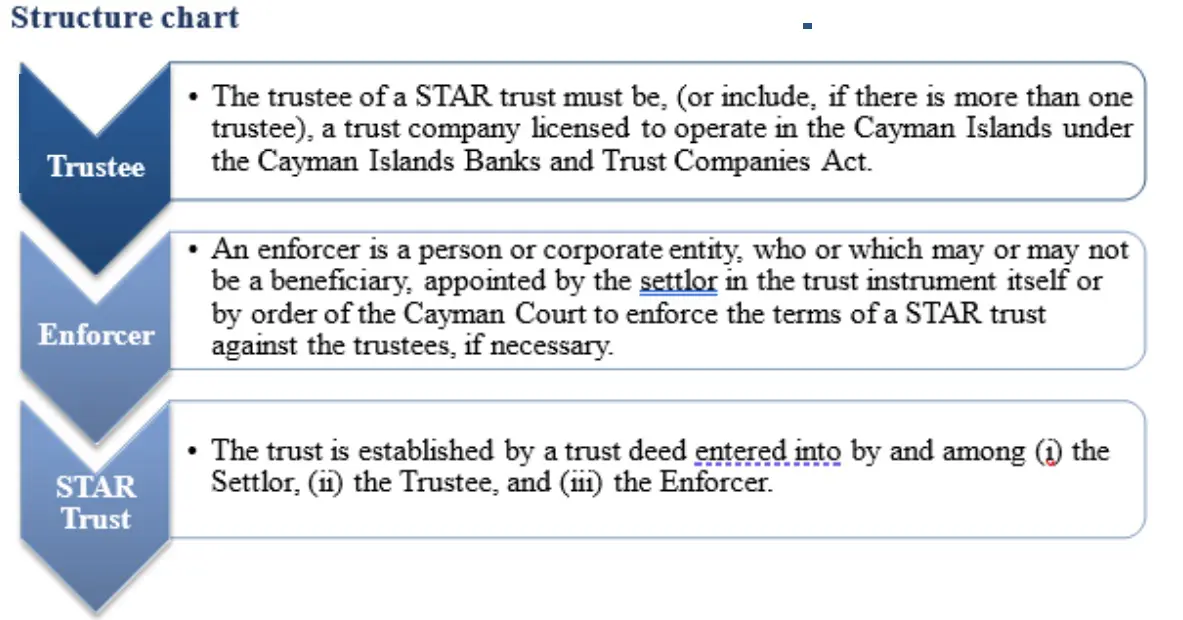
  3. The Trustee of a STAR trust must be or must include a trust company licensed to conduct trust business in the Cayman Islands. This adds a level of oversight and regulation above and beyond other jurisdictions. There are criminal sanctions attached if these requirements are overlooked or bypassed.
  4. STAR trusts must have an “Enforcer” who is the only individual person or corporate entity with legal standing to enforce the terms of the STAR trust. The STAR trust regime makes a clear distinction between the capacity to benefit from a STAR trust and the actual capacity to enforce such a trust. The effect is to remove rights of beneficiaries not only to enforce the trust, but also their right to seek disclosure of information regarding the trust and its ongoing administration.
  5. The rule against perpetuities does not apply to STAR trusts, which may be created for an unlimited duration (or not, depending on the terms of the trust deed), which eliminates the risk of a resulting trust in favour of the settlor at the end of the perpetuity period and the adverse tax consequences which may flow from such an event.
  6. A STAR trust cannot hold land in the Cayman Islands but may hold an interest in a company, partnership or other entity which does.


3. What are STAR Trusts used for?

STAR trusts are commonly used for, among other things, the following.

  1. To create dynasty-style trusts for multiple generations primarily for holding treasured family assets, investments, and preserving shares in family businesses.
  2. To create trusts for philanthropic purposes which are outside of the scope of what would be considered charitable as a matter of Cayman Islands law.
  3. To create trusts which restrict the rights of troublesome beneficiaries who may be tempted to challenge the trust, to seek to obtain information in relation to the trust, among other things.
  4. To create trusts which are unrestricted by a perpetuity period.
  5. To create trusts which benefit persons while at the same time achieving alternative objectives such as the continuation of family businesses.
  6. To form “Special Purpose Vehicles” for a wide range of commercial transactions in a safe, flexible, and bankruptcy remote manner.
  7. To act as a vehicle to hold shares in a private company, thus allowing a family member (or members) to retain a degree of control over the administration of the underlying trusts and influence decisions which may affect the underlying trusts and the assets they hold (most typically, shares in a family business).
  8. For clubs and associations whereby their members can enforce terms of contracts without actually being a party to the contract. Also, upon the dissolution of the club or association, the contributed assets may be returned to members in portions specified in the trust deed, rather than in an ad-hoc manner.

4. Registration

The Trustee of a STAR trust must be or must include a trust company licensed to conduct trust business in the Cayman Islands. This adds a level of oversight and regulation above and beyond other jurisdictions.
The Trustee of a STAR trust is also required to keep, in its Cayman Islands office, a documentary record of:

  1. the terms of the STAR trust,
  2. the identity of the Trustee and the enforcer(s),
  3. all settlements of the property upon trust and the identity of the settlor(s),
  4. the property subject to the STAR trust at the end of each of its accounting years, and
  5. all distributions or applications of the trust property.

These additional obligations clarify any uncertainty in the common law regarding the retention of trust records and other vital information. These requirements therefore standardize and clarify important administrative expectations specifically imposed on STAR trust Trustees.

Registration
There is no requirement to register a STAR trust with the regulatory authorities in the Cayman Islands, hence confidentiality is preserved. In fact, all trust deeds (except “exempted trusts”) are exempt from registration. Therefore, the details of a STAR trust will remain confidential, subject only to disclosure as may be required by an order of the Cayman Islands courts.

Conclusion
With sound professional advice, the STAR trust provides a flexible and valuable tool for structured financing arrangements, as well as for the estate and financial planning of private parties seeking a safe and reliable trust mechanism to satisfy their specific needs and purposes.

Further Assistance
This publication is not intended to be a substitute for specific legal advice or a legal opinion. If you require further advice relating to the matters discussed in this Briefing, please contact us. We would be delighted to assist.

E: gary.smith@loebsmith.com
E: robert.farrell@loebsmith.com
E: elizabeth.kenny@loebsmith.com
E: vivian.huang@loebsmith.com
E: faye.haung@loebsmith.com

E: edmond.fung@loebsmith.com

Introduction

Megatrends we see developing in the offshore investment funds market.

Large institutions are increasingly making allocations to digital assets and/or investment funds investing in digital assets.

Tokenisation of assets being seen as a pathway to access new investors and enhance liquidity.

Development of digital assets as a legitimate asset class in which to invest. Economies of Scale that benefit investment funds and investors in offshore jurisdictions

BVI developing a reputation as the natural home of start-up managers and some emerging managers to establish their investment funds.

View Full PDF

Share to WeChat

“Scan QR Code” in WeChat and tap ··· to share.

QR Code

Loeb Smith Attorneys is pleased to announce that Gary Smith has been recognized again as one of the top-rated practising offshore lawyers by the prestigious Asia Business Law Journal’s A-List of top offshore lawyers.

The A-List: Top Offshore Lawyers is based on interviews with thousands of in-house counsels in Asia and partners at international and onshore law firms in the region.

Gary Smith is Head of the Firm’s Investment Funds Group and is known for his ability to deliver pragmatic and well-thought-through solutions to complex technical issues. He advises on Cayman Islands & BVI investment funds, private equity investments, M&A, fintech, blockchain & virtual assets transactions, corporate, and corporate finance and is regularly praised by clients in international legal directories for his “strong client-relationships and is highly regarded by sources in North America and Asia” and “his knowledge impresses me and his creativity is very good. He is also very patient and intelligent”.

View Full PDF 

Share to WeChat

“Scan QR Code” in WeChat and tap ··· to share.

QR Code

Overview

Robert is a Partner based in Loeb Smith’s office in the Cayman Islands. Robert relocated to the Cayman Islands from the UK in 2021 where he practiced as a Banking & Finance lawyer for 12 years. Robert now advises on a broad range of matters covering corporate (including M&A) commercial, banking & finance, investment funds, crypto and securities investment business matters.

In addition to his legal qualifications, Robert also has qualifications from the London School of Economics & Political Science in Real Estate Economics and Finance.

Experience

Robert has the following experience and expertise:

  • Corporate – advising on cross-border M&A, statutory mergers, joint ventures, acquisitions, reorganizations, private equity and merger take privates;
  • Commercial – undertaking general commercial advisory work ranging from trade and business licensing, local companies control licensing, strategic advice on economic substance compliance, consignment agreements, services agreements and IP licensing;
  • Banking & Finance – advising lenders and borrowers on international finance transactions, including advising on local security registration requirements and providing legal opinions to international lenders on local law matters;
  • Investment Funds – advising on the formation and launch of investment funds across a broad range of strategies and sectors (including cryptocurrency / digital asset funds), as well as portfolio investments and financing throughout the life of the investment fund; and
  • Crypto / Web3.0 – advising on client’s regulatory status under local ‘VASP’ legislation and applying for registrations and licenses as required.

Unlike many lawyers, Robert can ‘evaluate the numbers’, enabling him to provide advice in a commercially relevant context.

Latest Updates and News

INSIGHTS | 15 May 2026

Enforcement of Foreign Judgments and Arbitration Awards in the British Virgin Islands

Learn about the enforcement of foreign judgments and arbitration awards in the British Virgin Islands, including procedures for monetary and non-monetary judgments, as well as the recognition and enforcement of Convention and non-Convention arbitral awards.

INSIGHTS | 14 May 2026

Key issues in series financing transactions from a BVI and a Cayman Islands law perspective

Explore key issues in series financing transactions from a BVI and Cayman Islands law perspective, including the legal advantages, common due diligence processes, and the specific features that make these jurisdictions attractive for startups and early-stage companies.

INSIGHTS | 11 May 2026

Cayman Islands – The latest position regarding tokenised funds

The Cayman Islands’ Mutual Funds (Amendment) Act, 2026 and the Cayman Islands’ Private Funds (Amendment) Act, 2026 both came into force as of March 24, 2026.

INSIGHTS | 23 April 2026

Key factors for launching a virtual assets business in the BVI

Learn the key factors for launching a virtual assets business in the BVI, including registration under the VASP Act, advantages of the jurisdiction, and the types of services regulated as virtual assets services, from exchanges to custody services.

INSIGHTS | 22 April 2026

Artificial Intelligence and Intellectual Property in the Cayman Islands and the BVI

The rapid advancement of artificial intelligence (AI) continues to raise complex questions about the applicability of intellectual property (IP) laws to AI and AI-generated works.

The Foundation Companies Act 2017 introduced a new corporate vehicle to the Cayman Islands – the “foundation company”. This company structure has several applications and is growing in popularity.

Foundation companies are governed primarily by the above-mentioned act together with certain provisions of the Companies Act (as revised) of the Cayman Islands, which apply to all types of company.

A foundation company is a legal person that is entirely distinct from that of its directors, members (where relevant), beneficiaries and founders. This means that a foundation company can own assets, and can sue and be sued.

The constitution

A foundation company is incorporated with a memorandum of association and articles of association (the “constitutional documents”), which set out the rights and responsibilities of the various parties who manage and who benefit from the foundation company.

A foundation company may also adopt bylaws that expand on the matters dealt with in the constitutional documents, and can even be used to confer specific rights on individuals or groups of beneficiaries. These bylaws may be kept private as they are not required to be filed with the Registrar of Companies.

Foundation companies therefore provide the functionality and flexibility of a trust but without any of the complexities associated with trust administration.

The following classes of person will be involved in the management of a foundation company:

  • Directors. A foundation company will typically be managed by its board of directors, who owe fiduciary duties to the company.
  • Secretary. A foundation company must have a secretary who is licensed or permitted to provide company management services in the Cayman Islands. The foundation company’s registered office must be at the secretary’s business address.
  • Supervisor. If a foundation company either chooses not to have any members, or at any time ceases to have any members, it is required to appoint a supervisor, who oversees its management but crucially has no ownership rights or financial entitlement. In the absence of any members, this provides necessary checks and balances on the board of directors to ensure that the foundation company is being properly managed, and is conducting its business in accordance with its constitutional documents, the requirements of any bylaws, and applicable law.
  • Founder. The founder is similar to a settlor in the context of a trust. Founders have no specific rights or powers in respect of the foundation company unless such rights and powers are specified in the constitutional documents and/or in the bylaws. It is common for the constitutional documents to grant the founder the power to appoint or remove directors and beneficiaries.

In addition, the following classes of person can be associated with foundation companies:

  • Members. Members are not automatically entitled to participate financially in the success of the foundation company unless the constitutional documents or bylaws provide otherwise.
  • Beneficiaries. Beneficiaries are, subject to the constitutional documents and bylaws, able to participate financially in the foundation company.

Characteristics, common uses

The foundation company structure is flexible. The roles and entitlements of members and beneficiaries are neither prescribed nor proscribed. It is therefore entirely within the discretion of the founders of the foundation. The two most common applications for foundation companies are as family offices/family trusts, or in the establishment of decentralised autonomous organisations (DAOs).

Family offices. The benefits of using a foundation company to operate a family office/family trust include the flexibility available to founders to determine the extent of any entitlement of beneficiaries, and the extent of their direct involvement/rights to information in the underlying business. The foundation company has a separate legal personality and overcomes issues of recognition and taxation in jurisdictions that don’t otherwise recognise common law trusts. For family offices with interests and assets across the globe, this is a significant advantage in terms of convenience and the potential for time and cost savings in what would otherwise be “difficult” jurisdictions.

DAOs. DAOs often do not have legal personality, and it is necessary for projects that involve DAOs to incorporate an entity that will act as the counterparty to any contractual relationships outside of the DAO (e.g. service providers). The ability for foundation companies to not have members is particularly attractive as this is consistent with the decentralised and “ownerless” nature of a DAO. Also, the ability to provide for bespoke arrangements and rights within the bylaws adds to the attractiveness of foundation companies.

View Full PDF

E: robert.farrell@loebsmith.com
E: elizabeth.kenny@loebsmith.com


This article was first published in the Asia Business Law Journal.
https://law.asia/cayman-islands-foundation-companies/


Share to WeChat

“Scan QR Code” in WeChat and tap ··· to share.

QR Code

Exempted limited partnerships are popular offshore investment vehicles in the Cayman Islands, especially with private equity investors and venture capitalists who have, or may be looking to, set up their investment vehicle by way of the established GP-LP structure.

As provided in the Exempted Limited Partnership Act of the Cayman Islands (as amended) (“ELP Act”), a limited partner shall not take part in the conduct of the business of an exempted limited partnership in its capacity as a limited partner1. All letters, contracts, deeds, instruments or documents whatsoever shall be entered into by or on behalf of the general partner (or any agent or delegate of the general partner) on behalf of the exempted limited partnership2. Notwithstanding these arrangements and the lack of legal personality, limited partners are nonetheless guaranteed by statute a right to information on the state and financial performance of the partnership.

Section 22 of the ELP Act indeed provides that “subject to any express or implied term of the partnership agreement, each limited partner may demand and shall receive from a general partner true and full information regarding the state of the business and financial condition of the exempted limited partnership”.

It follows that the limited partners’ statutory right to information may be limited by the terms of the limited partnership agreement. In this Legal Insight, we examine three cases heard in the Cayman Islands courts which provide some helpful clarification on limited partners’ overriding right to information.

Case 1: Dorsey Ventures Limited v XIO GP Limited3

In this case, the general partner (XIO GP Limited) refused the limited partner’s (Dorsey Ventures Limited) request for information and documents regarding the financial condition of the fund (i.e. the limited partnership) on the basis that the limited partnership agreement contained an express provision which entitled the limited partners to receive the fund’s annual audited accounts and unaudited quarterly accounts by certain dates or in any event as soon as practicable. The general partner argued that, as a matter of construction, this contractual provision meant that the general right to information under section 22 of the ELP Act which would have entitled the limited partners to more information than that expressly provided in the limited partnership agreement was excluded. In its argument in the case, the general partner also tried to rely on the principle set in the case of Marks & Spencer Plc v BNP Paribas Securities Services Trust Co (Jersey) Ltd4 where a term would be implied in a commercial contract where ‘it satisfies the test of business necessity’5 or ‘it is so obvious that it goes without saying’.6

The Court rebutted the general partner’s arguments in the Dorsey Ventures case and ultimately allowed the limited partner’s request for more information than that stated in the limited partnership agreement. In her decision, the Judge held that the right to receive true and full information regarding the state of the business and financial condition of the exempted limited partnership under section 22 of the ELP Act when read in conjunction with section 21 of the ELP Act, contemplates a broader class of information than merely audited and unaudited accounts as provided in the limited partnership agreement.

Section 21 of the ELP Act provides that:

“a general partner shall keep or cause to be kept proper books of account including, where applicable, material underlying documentation including contracts and invoices, with respect to –

(a) all sums of money received and expended by the exempted limited partnership and matters in respect of which the receipt of expenditure takes place;
(b) all sales and purchases of goods by the exempted limited partnership; and
(c) the assets and liabilities of the exempted limited partnership”.

The Judge also held that a reasonable man with background knowledge of the parties could not have understood the parties to have intended to exclude the statutory right to information under section 22 of the ELP Act in the absence of express wording in the limited partnership agreement to that effect.

This judgment clarifies the extent of the statutory right to information under section 22 of the ELP Act; any party wanting to restrict or exclude such statutory right will have to expressly do so in the limited partnership agreement.

Case 2: In the matter of Gulf Investment Corporation et al .v. The Port Fund LP et al7

In this case, the limited partners made a request for disclosure of information relating to the limited partnership’s business by the general partner under section 22 of the ELP Act. The general partner raised concerns that without appropriate safeguards the information that was requested may have been misused for other purposes by the limited partners and particulars were provided to the Court. The general partner also objected to the production of proprietary working papers in response to the request and the provision of any papers which would contain privileged material.

The Court found that the motives and bona fides of the limited partners’ request is irrelevant to their right to demand true and full information as such right is expressed in unqualified terms in section 22 of the ELP Act. The Court also dismissed the assertion of privilege and the proprietary nature of the working papers on the basis that there is no condition in the ELP Act or the limited partnership agreement relating to working papers or material that is covered by legal privilege. The Judge in the case noted that as a matter of Cayman Islands law, a general partner cannot assert privilege against a limited partner unless the legal advice itself concerns a dispute with a limited partner8. Where a general partner seeks legal advice for the benefit of the partnership (as opposed to for its own benefit) in litigation against the other partners, the general partner will not be entitled to assert privilege against the limited partner. As to the working papers, the Judge in the case noted that there was nothing in section 22 of the ELP Act (or the limited partnership agreement) that suggests that there is any limitation to be placed on the information that was required to be provided to satisfy the ‘true and full’ requirement.

This judgment highlights once again the overarching and unqualified nature of the limited partners’ statutory right to information under section 22 of the ELP Act.

Case 3: In the matter of Neoma Manager (Mauritius) Limited et al9

In this case, there was a dispute on the accuracy of the calculations of the limited partners’ capital account balances in the fund/limited partnership and the limited partners made an application seeking true and full information regarding the state of the business and financial condition of the limited partnership, including, among other things, various categories of information and documents which underpinned the investment manager’s calculations. The general partner and investment manager refused to provide the information and documents requested, asserting, among things, that the requests were disproportionate, that the information is not readily available and that the information already provided was sufficient to satisfy the requirement under section 22 of the ELP Act.

The Court decided in favour of the limited partners and the Judge’s decision was a welcome reminder of how “true and full” information about a partnership’s business state and financial condition is a “very wide target to aim at” and cannot be easily resisted.

In his judgment, Justice Parker made the following observations which provide some helpful guidance on the interpretation of section 22 of the ELP Act by the Cayman Islands courts:

  • A limited partner may make a relevant “demand” of a general partner for material under section 22 of the ELP Act. Once that demand is made, the general partner is then under an obligation to provide the requested material provided it falls within the wide ambit of the section.
  • The entitlement to “true and full information” regarding “the state of the business and financial condition of the exempted limited partnership” arises from the general partner’s position as agent and fiduciary of the partnership and, since the exempted limited partnership has no separate legal personality, as agent of each of the limited partners.
  • The limited partners, as the economic owners of the partnership, are entitled to the same information that is available to the general partner concerning the business and financial affairs of the partnership in this regard so that they may be properly informed as to what has been done on their behalf.
  • Where the general partner does not have the information requested under section 22 of the ELP Act, it should make all reasonable efforts to obtain it from third parties in order to fulfill its obligation under section 22 of the ELP Act and if such information does not exist, it should explain what searches have been conducted and why it is not possible to retrieve the requested information.

Conclusion

The three judgments reported above all have a common theme which is that limited partners have an overriding general right to information under section 22 of the ELP Act and the only way to limit such right is to modify it by making express reference to it in the limited partnership agreement. Any other attempt to rebut the application of such right is likely to be dismissed by the Cayman Islands courts.

View Full PDF

1 Section 14(1) ELP Act
2 Section 14(2) ELP Act
3 FSD 38 of 2018, unreported 22 October 2018
4 [2016] AC 742
5 Marks & Spencer Plc v BNP Paribas Securities Services Trust Co (Jersey) Ltd AC 742 [17]
6 Marks & Spencer Plc v BNP Paribas Securities Services Trust Co (Jersey) Ltd AC 742 [18]
7 FSD 235 of 2019 and FSD 13 of 2020, unreported 16 June 2020
8 Re Torchlight, unreported McMillan J 26 February 2016
9 FSD 322 of 2020; FSD 141 of 2021; FSD 52 of 2022 (RPJ)

This publication is not intended to be a substitute for specific legal advice or a legal opinion. For specific advice on the matters covered in this Legal Insight, please contact your usual Loeb Smith attorney.

Share to WeChat

“Scan QR Code” in WeChat and tap ··· to share.

QR Code

Overview

Rotsen is based in Loeb Smith’s Cayman Islands office where he focuses on client relationships and ensuring adherence to compliance and regulatory requirements.

Latest Updates and News

INSIGHTS | 15 May 2026

Enforcement of Foreign Judgments and Arbitration Awards in the British Virgin Islands

Learn about the enforcement of foreign judgments and arbitration awards in the British Virgin Islands, including procedures for monetary and non-monetary judgments, as well as the recognition and enforcement of Convention and non-Convention arbitral awards.

INSIGHTS | 14 May 2026

Key issues in series financing transactions from a BVI and a Cayman Islands law perspective

Explore key issues in series financing transactions from a BVI and Cayman Islands law perspective, including the legal advantages, common due diligence processes, and the specific features that make these jurisdictions attractive for startups and early-stage companies.

INSIGHTS | 11 May 2026

Cayman Islands – The latest position regarding tokenised funds

The Cayman Islands’ Mutual Funds (Amendment) Act, 2026 and the Cayman Islands’ Private Funds (Amendment) Act, 2026 both came into force as of March 24, 2026.

INSIGHTS | 23 April 2026

Key factors for launching a virtual assets business in the BVI

Learn the key factors for launching a virtual assets business in the BVI, including registration under the VASP Act, advantages of the jurisdiction, and the types of services regulated as virtual assets services, from exchanges to custody services.

INSIGHTS | 22 April 2026

Artificial Intelligence and Intellectual Property in the Cayman Islands and the BVI

The rapid advancement of artificial intelligence (AI) continues to raise complex questions about the applicability of intellectual property (IP) laws to AI and AI-generated works.

Overview

Cindy is based in Loeb Smith’s Cayman Islands office with her role being to liaise with clients on a range of Compliance, Governance and Regulatory Affairs. Her commitment lies in fostering strong client partnerships while ensuring adherence to regulatory requirements. With her expertise in navigating complex compliance landscapes, Cindy provides proactive guidance to assist clients in adeptly mitigating risks and upholding compliance standards.

Latest Updates and News

INSIGHTS | 15 May 2026

Enforcement of Foreign Judgments and Arbitration Awards in the British Virgin Islands

Learn about the enforcement of foreign judgments and arbitration awards in the British Virgin Islands, including procedures for monetary and non-monetary judgments, as well as the recognition and enforcement of Convention and non-Convention arbitral awards.

INSIGHTS | 14 May 2026

Key issues in series financing transactions from a BVI and a Cayman Islands law perspective

Explore key issues in series financing transactions from a BVI and Cayman Islands law perspective, including the legal advantages, common due diligence processes, and the specific features that make these jurisdictions attractive for startups and early-stage companies.

INSIGHTS | 11 May 2026

Cayman Islands – The latest position regarding tokenised funds

The Cayman Islands’ Mutual Funds (Amendment) Act, 2026 and the Cayman Islands’ Private Funds (Amendment) Act, 2026 both came into force as of March 24, 2026.

INSIGHTS | 23 April 2026

Key factors for launching a virtual assets business in the BVI

Learn the key factors for launching a virtual assets business in the BVI, including registration under the VASP Act, advantages of the jurisdiction, and the types of services regulated as virtual assets services, from exchanges to custody services.

INSIGHTS | 22 April 2026

Artificial Intelligence and Intellectual Property in the Cayman Islands and the BVI

The rapid advancement of artificial intelligence (AI) continues to raise complex questions about the applicability of intellectual property (IP) laws to AI and AI-generated works.

Follow us on WeChat and receive latest news

wechat-logo WeChat QR