 About Loeb Smith
 People
 Sectors
 Expertise
 News and Announcements
 News
News Legal Insights
 Legal Briefings
 Media
Media Locations
 Subscribe Newsletters
 Contact
Introduction
Under the Companies Act (As Revised) of the Cayman Islands (the “Companies Act”), the Registrar of Companies (the “Registrar”) will de-register a Cayman Islands exempted company incorporated with limited liability and with a share capital (the “Applicant”) which proposes to be registered by way of continuation as a body corporate limited by shares under the laws of any jurisdiction outside the Cayman Islands (the “Relevant Jurisdiction”) if:
1.1 the Applicant proposes to be registered by way of continuation in a jurisdiction which permits or does not prohibit the transfer of the Applicant;
1.2 the Applicant has paid to the Registrar a fee equal to three (3) times the annual fee that would have been payable in the January immediately preceding the application for de-registration; and
1.3 the Applicant has filed with the Registrar, notice of any proposed change in its name and of its proposed registered office or agent for service of process in the Relevant Jurisdiction.
Transfer Procedure
In order to be effective, the transfer must be approved in accordance with the Applicant’s Memorandum and Articles of Association. Usually, a special resolution of the shareholders of the Applicant will be required. Depending on the terms of the Applicant’s Articles of Association, it may even be necessary to amend the Applicant’s Memorandum and Articles of Association to permit de-registration. The directors of the Applicant must approve the de-registration and transfer by way of continuation.
An affidavit must be sworn by a director of the Applicant. The director must swear that, having made due enquiry, he or she is of the opinion that:
i. no petition or other similar proceeding has been filed and remains outstanding or order made or resolution adopted to wind up or liquidate the Applicant in any jurisdiction;
ii. no receiver, trustee or administrator or other similar person has been appointed in any jurisdiction and is acting in respect of the Applicant, its affairs or its property or any part thereof;
iii. no scheme, order, compromise or other similar arrangement has been entered into or made whereby the rights of creditors of the Applicant are and continue to be suspended or restricted;
iv. the Applicant is able to pay its debts as they fall due;
v. the application for de-registration is bona fide and not intended to defraud creditors of the Applicant;
vi. any consent or approval to the transfer required by any contract or undertaking entered into or given by the Applicant has been obtained, released or waived, as the case may be;
vii. the transfer is permitted by, and has been approved in accordance with, the Memorandum and Articles of Association of the Applicant;
viii. the laws of the Relevant Jurisdiction with respect to transfer have been or will be complied with; and
ix. once re-registered the Applicant will continue as a body corporate limited by shares under the laws of the Relevant Jurisdiction.
The affidavit must also include a statement of the assets and liabilities of the Applicant made up to the latest practicable date before the making of the affidavit.
The Applicant must deliver to the Registrar an undertaking signed by a director that notice of the transfer has been or will be given within 21 days to the secured creditors of the Applicant (if there are no secured creditors an appropriate negative statement to that effect may be included in the director’s affidavit).
The Registrar is required to publish in the Cayman Islands Gazette details of the de-registration, the jurisdiction under whose laws the Applicant will be registered or existing and the name of the Applicant if changed from the current name.
In so far as it is possible, it is advisable that the re-registration of the Applicant in the Relevant Jurisdiction is co-ordinated with its de-registration in the Cayman Islands so that both events take place on the same day. If not, there could be a period in which the Applicant is not registered in any jurisdiction (or is registered in two at the same time).
The Registrar, if she is not aware of any other reason why it would be against public interest to de-register the Applicant, will issue a de-registration certificate under her hand and seal of office stating that the Applicant has been de-registered as an exempted company and enter into the Register of Companies the date of de-registration.
Effect of De-Registration
From the date of the de-registration the Applicant shall cease to be an exempted company under and subject to the Companies Act.
From the date of de-registration the Applicant shall continue as a company under the laws of the Relevant Jurisdiction provided that this shall not operate to:
i. create a new legal entity;
ii. prejudice or affect the identity or continuity of the Applicant as previously constituted;
iii. affect the property of the Applicant;
iv. affect any appointment made, resolution passed or any other act or thing done in relation to the Applicant pursuant to a power conferred by the Memorandum and Article of Association of the Applicant or by the laws of the Cayman Islands;
v. affect the rights, powers, authorities, functions and abilities or obligations of the Applicant or any other person; or
vi. render defective any legal proceedings by or against the Applicant any legal proceedings that could have been continued or commenced by or against the Applicant before its de-registration may, notwithstanding re-registration, be continued or commenced by or against the Applicant after de-registration.
This Briefing Note is not intended to be a substitute for specific legal advice or a legal opinion. It deals in broad terms only and is intended to merely provide an overview and general guidance on the de-registration and transfer by way of continuation of Cayman Islands exempted companies. For more specific advice on the de-registration and transfer by way of continuation of Cayman Islands exempted companies, please refer to your usual Loeb Smith contact or:
Gary Smith
Partner
Loeb Smith Attorneys
Cayman Islands
T: +1 (345) 749 7590
M: +1 (345) 525 0900
Elizabeth Kenny
Senior Associate
Loeb Smith Attorneys
Cayman Islands
T: +1 (345) 749 7594
M: +1 (345) 325 4824
In certain circumstances the official liquidator of a Cayman company may be able to take action to recover assets which have been transferred in the run up to the company’s insolvency. It is important for those concerned with the affairs of a Cayman company in the twilight of insolvency to be aware of the statutory powers available to the official liquidator and the Grand Court in the Cayman Islands.
Summary
This Briefing sets out, among other things, the following positions under Cayman law with respect to matters to consider when a Cayman company faces liquidity issues and financial difficulties which might lead to the relevant entity’s insolvency:
i. The liquidator of a Cayman company can apply to the Court to set aside a transaction of the company in favour of any creditor, at a time when the company is unable to pay its debts, where such transaction was entered into with a view to giving such creditor a preference over other creditors, if such transaction was made, incurred, taken within six (6) months immediately preceding the commencement of a liquidation of the company.
ii. The Directors of a Cayman company, the General Partner of an ELP and the Manager of an LLC should exercise caution and seek legal advice from Cayman legal counsel where there is any uncertainty about the solvency (on a cashflow basis) of the applicable Cayman entity which they are managing. These situations might, for example, arise within the context of an investment fund with severe liquidity issues.
iii. Every disposition of property made at an undervalue by or on behalf of a Cayman company with intent to defraud its creditors is voidable at the instance of its official liquidator.
iv. If in the course of the winding up of a Cayman company it appears that any business of the company has been carried on with intent to defraud creditors of the company or
creditors of any other person or for any fraudulent purpose, the liquidator may apply to the Court for a declaration that any persons who were knowingly parties to the carrying on of the business with intent to defraud creditors of the company or creditors of any other person or for any fraudulent purpose are liable to make such contributions, if any, to the company’s assets as the Court thinks proper.
v. When Directors of a Cayman company are considering their fiduciary duties, the weight to be given to the interests of creditors will increase as the company’s financial difficulties become increasingly serious. Creditors’ interests will take precedence over the interests of the company’s shareholders at the point where insolvent liquidation or administration is inevitable.
Voidable preferences
The Companies Act (As Revised) of the Cayman Islands (the “Act”) provides that “every conveyance or transfer of property, or charge thereon, and every payment obligation and judicial proceeding, made, incurred, taken or suffered by any company in favour of any creditor at a time when the company is unable to pay its debts within the meaning of section 93 with a view to giving such creditor a preference over the other creditors shall be voidable upon the application of the company’s liquidator if made, incurred, taken or suffered within six months immediately preceding the commencement of a liquidation.”
It is important to note that a payment to a “related party” of the Cayman company shall be deemed to have been made with a view to giving a creditor a “preference” and therefore would be voidable upon the application of the company’s liquidator if made, incurred, taken or suffered within six (6) months immediately preceding the commencement of a liquidation.
A creditor is treated as a “related party” if it has the ability to control the Cayman company or exercises significant influence over the company in making financial and operating decisions.
When is a company unable to pay its debts?
A Cayman company is deemed to be unable to pay its debts if:
(a) it fails to comply with a statutory demand;
(b) the company fails to satisfy a judgment debt; or
(c) it is proven to the satisfaction of the Court that the company is unable to pay its debts.
Commencement of a liquidation
Under Cayman law, the compulsory winding up of a company is deemed to commence at the time of the presentation of the petition for the winding up or, in the case of a voluntary liquidation, at the time of the resolution or expiry of the relevant period, or occurrence of an event provided by the company’s Articles of Association upon which the company is to be wound up, or in the case where a restructuring officer has been appointed pursuant to section 91B or 91C of the Act and the order appointing the restructuring officer has not been discharged, at the relevant time on the date of the presentation of the petition to appoint a restructuring officer pursuant to section 91B of the Act.
Dispositions at an Undervalue
Every disposition of property made at an undervalue by or on behalf of a company with intent to defraud its creditors shall be voidable at the instance of its official liquidator (i.e. the liquidator of a Cayman company which is being wound up by order of the court or under the supervision of the court and includes a provisional liquidator). The official liquidator bears the burden of establishing an “intent to defraud” (i.e. the official liquidator must establish that there was an intention to wilfully defeat an obligation owed to a creditor). The intention to defeat a creditor needs only be “a” purpose and not the sole or dominant purpose. No legal proceedings may be brought by the official liquidator under after six (6) years following the date of the relevant disposition or transaction.
The term “undervalue” in relation to a disposition of a company’s property means (i) the provision of no consideration for the disposition; or (ii) a consideration for the disposition the value of which in money or money’s worth is significantly less than the value of the property which is the subject of the disposition.
However, the rights of the transferee of such property are subject to some protection. In the event that any disposition is set aside and the Court is subsequently satisfied that the transferee has not acted in bad faith: (i) the transferee will have a first and paramount charge over the property which is the subject of the disposition, of an amount equal to the entire costs properly incurred by the transferee in the defence of the action or proceedings; and (ii) the relevant disposition will be set aside subject to the proper fees, costs, pre-existing rights, claims and interests of the transferee (and of any predecessor transferee who has not acted in bad faith).
Fraudulent Trading and Liability to Contribute
If in the course of the winding up of a Cayman company it appears that any business of the company has been carried on with intent to defraud creditors of the company or creditors of any other person or for any fraudulent purpose, the liquidator (i.e. official liquidator or voluntary liquidator) may apply to the Court for a declaration that any persons who were knowingly parties to the carrying on of the business with intent to defraud creditors of the company or creditors of any other person or for any fraudulent purpose are liable to make such contributions, if any, to the company’s assets as the Court thinks proper. Directors of a Cayman company will face the real risk of liability when managing a company’s business if that business is carried on fraudulently. Unlike dispositions at an undervalue, there is no applicable limitation period for fraudulent trading.
Fiduciary Duties of Directors of Companies facing Insolvency
In addition to Cayman companies, Cayman Islands law as stated above may also apply to limited liability companies (LLCs) and exempted limited partnerships (ELPs). Accordingly, the Directors of a Cayman company, the General Partner of an ELP and the Manager of an LLC should exercise caution and seek legal advice from Cayman legal counsel where there is any uncertainty about the solvency (on a cashflow basis) of the applicable Cayman entity which they are managing. These situations might, for example, arise within the context of an investment fund with severe liquidity issues. Directors should consider carefully the point at which creditors’ interests take priority over shareholders’ interests and how those interests are best served (e.g. appointment of a liquidator or a restructuring officer). Failure to seek urgent advice on their duties could increase the Directors’ exposure to risk of personal liability.
The fiduciary duty of directors is to act in good faith in the interests of a Cayman company. The interests of the company have until recent times been treated as being the interests of its members as a whole. However, in the UK Supreme Court’s decision given on 5 October 2022 in BTI 2014 LLC (Appellant) v Sequana SA and others (Respondents), which is persuasive authority in the Cayman Islands, it was re-affirmed that directors of financially distressed companies are required to consider, as one of the relevant factors, the interests of creditors. The Supreme Court concluded that the weight to be given to the interests of creditors will increase as the company’s financial difficulties become increasingly serious. Creditors’ interests will take precedence over the interests of the company’s shareholders at the point where insolvent liquidation or administration is inevitable.
Transactions which are void ab initio
Official liquidation
When a winding up order has been made, any disposition of the company’s property and any transfer of shares or alteration in the status of the company’s members made after the commencement of the winding up is, unless the Court otherwise orders, void.
The commencement of a winding-up is the date a petition is presented to the Court (or, if the company was first placed into voluntary liquidation, the passing of that resolution) rather than the date when the Court grants a winding-up order. Accordingly, any transaction during the period between the presentation of a winding-up petition and its resolution before the Court, will be avoided if a winding-up order is ultimately granted, unless the Court validates the transaction.
The presentation of a winding-up petition can have a material adverse effect on a company’s business, due to the uncertainty during the period between the presentation of a winding-up petition and its resolution before the Court. A validation order takes away that uncertainty and enables companies to continue to operate in the ordinary course of their business prior to the hearing of the petition.
Voluntary liquidation
Any transfer of shares, not being a transfer with the sanction of the liquidator, and any alteration in the status of the company’s members made after the commencement of a voluntary winding up is void. Unlike a compulsory liquidation, a transfer of the company’s property is not automatically void. There is not normally the same uncertainty with voluntary liquidations because upon the appointment of a voluntary liquidator, all of the powers of the directors cease and are displaced by the voluntary liquidator (except so far as the company in a general meeting or the voluntary liquidator sanctions their continuance). Accordingly, the transfer of property is not automatically void but any transfer of property effected by the company after the appointment of a voluntary liquidator should be authorized by the liquidator.
Further Assistance
This Briefing Note is not intended to be a substitute for specific legal advice or a legal opinion. For more specific advice on setting aside of antecedent transactions in the Cayman Islands, please contact any of:
About Loeb Smith Attorneys
Loeb Smith is an offshore corporate law firm, with offices in the British Virgin Islands, the Cayman Islands, and Hong Kong, whose Attorneys have an outstanding record of advising on the Cayman Islands’ law aspects and BVI law aspects of international corporate, investment, and finance transactions. Our team delivers high quality Partner-led professional legal services at competitive rates and has an excellent track record of advising investment fund managers, in-house counsels, financial institutions, onshore counsels, banks, companies, and private clients to find successful outcomes and solutions to their day-to-day issues and complex, strategic matters.
The Features and Ongoing Requirements of Exempted Limited Partnerships and their popularity for structuring Cayman Islands’ Private Equity Funds and Venture Capital Funds
Introduction
The most common structure for a Cayman Islands domiciled private equity fund (“PE fund”) or a Cayman Islands domiciled venture capital fund (“VC fund”) is as an exempted limited partnership (“ELP”) formed under the Exempted Limited Partnership Act (As Revised) (“ELP Act”). However, there are some Fund sponsors who choose a Cayman Islands exempted company or a Cayman Islands limited liability company (LLC) instead of an ELP as the corporate structure for their PE funds or VC funds for a number of reasons, including, their own specific onshore tax or regulatory requirements or benefits, or the investors are more familiar with or prefer to invest in a Cayman Islands exempted company or LLC.
Features of Exempted Limited Partnerships
Who can be General Partner?
The ELP is required to have a general partner (“GP”) which is most commonly a Cayman Islands exempted company. However, a foreign company upon its registration as a foreign company in the Cayman Islands or another ELP are able to qualify as the GP of an ELP. The list of persons who may qualify as a GP of an ELP also includes a limited partnership or limited liability partnership established in a recognized jurisdiction (e.g. United States, United Kingdom, Hong Kong, BVI, Singapore, Jersey, Luxembourg) (a “foreign limited partnership”) provided such a foreign limited partnership is registered as a foreign limited partnership in the Cayman Islands.
The Directors and shareholders of the GP are typically persons who are affiliated with the sponsor of the PE fund or VC fund. There is no requirement for any Director or shareholder of the GP to reside in the Cayman Islands. The GP will not be carrying on a ‘relevant activity’ for economic substance purposes in solely acting as the GP of an ELP.
Who are the Limited Partners?
The limited partners of the ELP will be the investors subscribing for limited partnership interests in the ELP. There are no restrictions on the number of limited partners that may be admitted to an ELP. There is no requirement for any limited partner of the ELP to reside in the Cayman Islands.
No Corporate Personality
An ELP does not have a legal personality of its own. The ELP is a legal arrangement between its GP and its limited partners and the terms of this legal arrangement are governed principally by the terms of the limited partnership agreement (“LPA”). The contractual rights and equitable interests in the assets of the ELP are held on trust for the ELP by its GP (and, if there is more than one GP, by the general partners jointly).
The ELP Act states clearly that (i) relevant provisions of the Cayman Islands’ Partnership Act are preserved in relation to ELPs, and (ii) the principles of common law and equity applicable to partnerships also apply to ELPs.
Tax Transparency
Not having its own legal personality, the ELP is generally regarded from an onshore tax perspective as being tax transparent (or as having “see-through”, “look-through” or “flow-though” status, which signify the same thing) with the effect that the ELP itself will not be liable to any onshore taxes; and value distributed by it will “flow-through” to the investors (and may be subject to local taxes in their hands).
Limited Liability
A limited partner of the ELP will not lose its limited liability unless it takes part in the conduct of the business of the ELP in its dealings with persons who are not partners of the ELP as if it was, for the period of participating in the ELP’s business, a general partner of the ELP. In such circumstances, the limited partner may be liable to a person who transacts business with the ELP with actual knowledge of the limited partner’s participation in the management/operation of the ELP and who then reasonably believed the limited partner to be a general partner.
Restrictions on participation by Limited Partners in the business of the Partnership
A limited partner may not participate in the conduct of the ELP’s business, and all contractual documents and papers must be executed by the GP as the contracting party acting on behalf of the ELP. As stated above, any limited partner participating in the management/operation of the ELP, as though it were a GP will, for that period of management participation be liable for the debts and obligations of the ELP, if the ELP goes insolvent, to any person transacting business with the ELP through the limited partner and who had actual knowledge of such limited partner’s participation and who reasonably believed that limited partner to be a general partner.
The ELP Act sets out certain non-exhaustive “safe harbours” of activities in which a limited partner may engage without risk of being deemed to be participating in the conduct/management of the ELP’s business and thereby losing its limited liability status. These include:
i. holding an office or interest in, or having a contractual relationship with, a general partner or being a contractor for or an agent or employee of the ELP or of a general partner or acting as a director, officer or shareholder of a corporate general partner;
ii. consulting with and advising a general partner or consenting or withholding consent to any action proposed, in the manner contemplated by the LPA, with respect to the business of the ELP;
iii. investigating, reviewing, approving or being advised as to the accounts or business affairs of the ELP or exercising any right conferred by the ELP Act;
iv. acting as surety or guarantor for the ELP either generally or in respect of specific obligations;
v. approving or disapproving an amendment to the LPA;
vi. calling, requesting, attending or participating in any meeting of the partners;
vii. taking any action that results in the winding up or the dissolution of the ELP;
viii. taking any action required or permitted by the LPA or by law to bring, pursue, settle or terminate any action or proceedings brought pursuant to section 33(2) of the ELP Act;
ix. serving on any board or committee of the ELP, a general partner, the limited partners or the partners, or by appointing, electing or otherwise participating in the choice of a representative or any other person to serve on any board or committee, or by acting as a member of any board or committee either directly or by or through any representative or other person, including giving advice or consenting, or refusing to consent, to any action proposed by the GP on behalf of the ELP and exercising any powers or authorities or performing any obligations as a member of that board or committee in the manner contemplated by the LPA;
The LPA may nonetheless provide for any amount of limited partner participation in the conduct of the ELP’s business.
Duties and obligations of the General Partner
A limited partner of an ELP owes no fiduciary duty to any other partners of the ELP or to the ELP itself in exercising any of its rights or performing any of its obligations under the LPA, except to the extent that it has expressly agreed to such fiduciary obligations in the LPA. Partners may nevertheless agree to set out certain fiduciary obligations in the LPA. They might, for example, agree to impose fiduciary duties on members of an LPAC or other advisory committees of the ELP.
Dealings with partnership interests
With the consent of the GP, a limited partner may transfer or grant a security interest over its partnership interest in the ELP, subject to it complying with any provisions in the LPA dealing with the requirement for consent. In the case of a transfer of a partnership interest, the transferee is typically admitted to the ELP in accordance with the formalities prescribed in the LPA. When the requirements for admission have been met, the ELP Act provides that the incoming partner is deemed to have agreed to and be bound by the terms and conditions of the LPA as if all parties had together duly executed and delivered it. The GP may also, subject to the terms of the LPA, transfer or grant a security interest in its general partnership interest with the written consent of any other general partner.
Default by Limited Partners
The LPA typically includes provisions setting out the consequences for a partner who fails to perform any of its obligations under the LPA. The LPA may, for example, provide that if a limited partner fails to contribute to the ELP such funds as have been committed, that partner shall forfeit its partnership interest. The ELP Act expressly provides that such provisions in the LPA will not be unenforceable solely on the basis that they may be penal in nature.
Return of contributions and Clawback
The ELP Act provides that if a limited partner receives a payment representing a return of any part of that person’s contribution or is released from any outstanding obligation in respect of that person’s commitment and at the time that the payment was made or the release effected:
i. the ELP is insolvent including where the payment or release causes the insolvency; and
ii. the limited partner has actual knowledge of the insolvency of the ELP,
then for a period of six (6) months commencing on the date of that payment or release but not thereafter, the limited partner shall be liable to the ELP for the amount of the payment or the due performance of the released obligation in respect of that person’s commitment in each case to the extent that the repayment or performance of the released obligation is necessary to discharge a debt or obligation of the ELP incurred during the period that the contribution or commitment represented an asset of the ELP.
Regulation
The Private Funds Act (2021 Revision) (the “PFA”) requires the registration of “private funds” with the Cayman Islands Monetary Authority (“CIMA”). A “private fund” includes an ELP that “offers or issues or has issued investment interests, the purpose or effect of which is the pooling of investor funds with the aim of enabling investors to receive profits or gains from such entity’s acquisition, holding, management or disposal of investments, where:
(a) the holders of investment interests do not have day-to-day control over the acquisition, holding, management or disposal of the investments; and
(b) the investments are managed as a whole by or on behalf of the operator of the private fund, directly or indirectly, but does not include:
(i) a person licensed under the Banks and Trust Companies Act (2021 Revision) or the Insurance Act, 2010 [Law 32 of 2010];
(ii) a person registered under the Building Societies Act (2020 Revision) or the Friendly Societies Act (1998 Revision); or
(iii) any non-fund arrangements”
The PFA applies to PE funds, VC funds, and other types of closed-ended funds which fall within the definition of “private fund” above and so ELPs need to consider (i) whether their business falls within the scope of a “private fund” as defined, and (ii) the issue of registration with CIMA.
An ELP may also be used for the purposes of operating a mutual fund and in that case, the GP of the ELP needs to consider (i) whether their business falls within the scope of a mutual fund, and (ii) the issue of registration with CIMA.
Timing
Formation and registration of an ELP and its GP can take place either on a same-day express basis with the payment of an express fee of approximately US$488 to the Registrar of Companies or within 5-7 business days on a standard basis.
Taxation
There are no capital gains, income, profits, withholding, estate or inheritance taxes in the Cayman Islands. The ELP can apply for (and can expect to obtain) an undertaking from the Cayman Islands government that no form of taxation that may be introduced in the Cayman Islands will apply to the ELP for a period of 50 years from the undertaking being given. The GP can also apply for (and can expect to obtain) an undertaking from the Cayman Islands government that no form of taxation that may be introduced in the Cayman Islands will apply to the GP for a period of 20 years from the undertaking being given.
Ongoing obligations of an ELP
Statutory registers
The GP has the responsibility for maintaining (or causing to be maintained) the following statutory registers:
i. Register of limited partners. This register must contain the name and address of each limited partner and the date on which a person became or ceased to be a limited partner. The register of limited partners can be kept anywhere in the world. If the register is kept at a place other than the registered office it must still be readily accessible, as it is required to be made available at the registered office should there be a notice or order for production under the Cayman Islands’ Tax Information Authority Act. The register of limited partners can be kept in electronic form and must be updated within 21 days of any changes. The ELP Act provides that subject to any express or implied term of the LPA, the register (and the record of address at which the register is maintained if it is not maintained at the registered office) is open to inspection by all partners and by any other person with the consent of the GP. If the GP defaults in complying with the above requirements for maintaining the register of limited partners it commits an offence and is liable on summary conviction to a fine of approximately US$12,200 for each day that the default continues and the GP is required to indemnify any person who thereby suffers any loss.
ii. Record of contributions and payments. The ELP Act also provides that the GP must maintain a record of contributions and payments which must show the amount and date of the contribution or contributions of each limited partner and the amount and date of any payment representing a return of the whole or any part of the contribution of any limited partner, and this record may be kept within or outside of the Cayman Islands but must be updated within 21 days of any change and be accessible to the registered office. These records are only available for inspection by any person (including a limited partner) with the consent of the GP.
iii. Register of security interests in relation to limited partnership interests. The ELP Act places an obligation on the GP to maintain or cause to be maintained at the ELP’s registered office, a register of security interests that have been granted over any limited partnership interest. When a security interest is granted over the whole or any part of a limited partnership interest, the ELP Act requires that notice must be given by the grantor (i.e., the limited partner) or the grantee (e.g., the lender) to the ELP at the registered office. The GP must then enter on the register of security interests (i) the identity of the grantor and the grantee, (ii) the relevant partnership interest, and (iii) the date on which notice of the security interest was validly served. The register must be open for public inspection during regular business hours. Any security interest has priority according to the time that the written notice is validly served at the registered office.
iv. Changes to the Section 9 Statement. Any changes to the Section 9 Statement of the ELP must be promptly notified to the Registrar of Exempted Limited Partnerships, by filing an amended statement signed by the GP. In general, changes must be notified within 60 days; however, a change to the GP is required to be filed within 15 days of the change and is not effective until that filing is made.
Accounts
The GP is required to keep (or cause to be kept) proper books of account. The records must be sufficient to give a true and fair view of the business and financial condition of the ELP and to explain its transactions. The accounting records are required to be retained for a minimum period of five (5) years. Subject to the terms of the LPA, each limited partner may demand and receive from the GP a true and full picture of the state of the business and financial condition of the ELP. There is no requirement for the accounts of an ELP to be audited each year under the ELP Act, although this may be required if the partnership is otherwise regulated, for example under the PFA or the Mutual Funds Act.
Annual requirements
The GP is required to make an annual return to the Registrar of Exempted Limited Partnerships in January each year regarding compliance with the ELP Act and to pay an annual return fee. The annual return will generally be signed on behalf of the GP by the ELP’s registered office agent.
This Briefing Note is not intended to be a substitute for specific legal advice or a legal opinion. It deals in broad terms only and is intended to merely provide an overview and general guidance on Cayman Islands exempted limited partnerships only. For more specific advice on the formation and usage of exempted limited partnerships as investment funds, and in corporate and financing transactions, please refer to your usual Loeb Smith contact or:
Gary Smith
Partner
Loeb Smith Attorneys
Cayman Islands
T: +1 (345) 749 7590
M: +1 (345) 525 0900
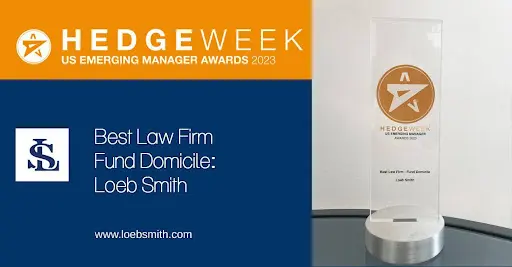
Loeb Smith wins award for Best Law Firm: Fund Domicile at the Hedgeweek US Emerging Manager Awards 2023.
We are happy to share with you that for the second time in less than three (3) months Loeb Smith’s Investment Funds team has been voted Best Law Firm: Fund Domicile at the Hedgeweek US Emerging Manager Awards 2023.
The win comes after being voted Best Law Firm: Fund Domicile at the Private Equity Wire US Emerging Manager Awards 2023 in March 2023.
Thank you to each and every one of you who voted for us and congratulations to our Investment Funds team for the consistent high quality of its legal advice and responsive service delivery across our offices in the BVI, the Cayman Islands and Hong Kong.
For the service provider categories, the nominated firms are based on a widespread survey of more than 100 emerging hedge fund managers.
The exclusive awards ceremony took place on June 8, 2023 at the Convene 101 in New York.
Share to WeChat
“Scan QR Code” in WeChat and tap ··· to share.
The Cayman Islands Monetary Authority (“CIMA”) published a new Rule – Corporate Governance for Regulated Entities (“Rule”) and a new Statement of Guidance relating to Corporate Governance – Mutual Funds and Private Funds (“Statement of Guidance”) on 14 April 2023. In essence, both the Rule and the Statement of Guidance apply to Cayman Islands mutual funds and private funds which are registered with and regulated by CIMA (“Regulated Funds”). The collective purpose of the Rule and Statement of Guidance is to provide a more robust framework of baseline minimum corporate governance standards pertaining to the operators of a Regulated Fund (“Operators”) in order to ensure sound and prudent governance of Regulated Funds.
The Statement of Guidance replaces the Statement of Guidance – Corporate Governance for Regulated Mutual Funds from 2013 and has been expanded in scope to cover private funds.
The Operators of Regulated Funds should carefully consider the Rule and the Statement of Guidance in order to understand the baseline standards for sound and prudent governance of Regulated Funds.
What is meant by the Operators of a Regulated Fund?
The Operators constitute the governing body of a Regulated Fund (i.e. the Board of Directors of a company, the General Partner of a limited partnership, the Manager of an LLC, or the Trustee(s) for a trust).
When do the Rule and Statement of Guidance come into effect?
The Statement of Guidance is in immediate effect from 14 April 2023. The Rule will come into effect on 14 October 2023.
What are the key points for Regulated Funds to consider?
1.Skill and expertise of the Operators – The Operators must constitute an appropriate number of individuals with expertise and skill to be competent to operate the Regulated Fund.
2.Structure – The governance structure of a Regulated Fund must be appropriate and suitable for effective oversight of the Regulated Fund, having taken into account the size, complexity, structure, nature of business and risk profile of the operations of the Regulated Fund.
3.Oversight function – Despite any outsourcing to service providers of the Regulated Fund (“Service Providers”), ultimate responsibility for overseeing and supervising the activities of the Regulated Fund remains with the Operators of a Regulated Fund.
4.Ongoing monitoring – The Operators should monitor and regularly take steps to satisfy themselves that the Regulated Fund is conducting its affairs in accordance with all applicable law and regulatory measures, in both the Cayman Islands and any other jurisdiction in which the Regulated Fund may operate. Furthermore, the Operators should request appropriate information from the Service Providers (including any Investment Manager) and professional advisors of the Regulated Fund to enable it to satisfy itself that the Regulated Fund is operating in compliance with applicable laws and regulatory measures.
5.Conflicts of Interest Policy – A Regulated Fund should have a written conflicts of interest policy, which is commensurate with the size, complexity, structure, nature of business and risk profile of the Regulated Fund. The Conflicts of Interest Policy does not need to be a standalone document – it can be included in the Regulated Fund’s offering document or constitutional documents. The Operators of a Regulated Fund must identify, disclose, monitor and manage all conflicts of interest consistent with the terms of the Conflicts of Interest Policy and additionally, all conflicts of interest should be disclosed in writing at least on an annual basis.
6.Operators’ Meetings – The Operators of a Regulated Fund should convene at least once a year. However, we would recommend that the frequency should be assessed by the Operators according to the type of Regulated Fund (e.g. a regulated mutual fund should typically convene more frequent meetings given the asset class, its trading frequency, and open-ended nature), the size, complexity and risk profile of the Regulated Fund. Where necessary, the Service Providers should be invited to meetings to provide any required input. A copy of the signed written minutes of any meeting of the Operators should be retained with the corporate records of the Regulated Fund.
7.Duties of the Operators – The Operators of a Regulated Fund should (i) exercise independent judgment (ii) act honestly and in good faith and (iii) always act in the best interests of the Regulated Fund and taking into consideration the interests of its investors as a whole. This requirement of independence still applies even if the Operators also carry out the investment management function of the Regulated Fund. Furthermore, the Statement of Guidance provides that if an Operator takes the decision to take on any additional funds, it should ensure it is able to perform its functions and duties in a responsible and effective way.
8.Communication with investors – The Statement of Guidance states that the Operators should communicate contemporaneously adequate information to the investors of the Regulated Fund of any material changes to the Regulated Fund.
9.Communication with CIMA – The Statement of Guidance sets out that the Operators are responsible for ensuring that CIMA is notified of any material changes to the appointments of Service Providers, that the Operators should ensure transparency with CIMA and notify CIMA of any matter which could materially and adversely affect the financial soundness of the Regulated Fund and any non-compliance with applicable laws and regulatory measures.
10.Review of Service Providers – The Statement of Guidance sets out that the Operators must review the service contracts with Service Providers to ensure that each Service Provider is carrying out its functions and regularly assess the suitability and capability of the Service Providers. The Operators must also regularly monitor whether the Investment Manager is performing in accordance with the investment criteria, strategy and any restrictions set out in the applicable offering document.
11.Review of financials – The Statement of Guidance sets out that the Operators should regularly monitor the Regulated Fund’s NAV policy and whether the calculation of NAV is being calculated in accordance with such policy.
12.Other policies – The Regulated Fund must adopt and oversee a written remuneration policy which must (i) as a minimum apply to the Operators, senior management and employees in control functions and (ii) must not induce excessive or inappropriate risk-taking, align with the corporate cultures and long-term interests of the Regulated Entity and have proper regard to the interests of the relevant stakeholders. Furthermore, the Regulated Fund should have policies on code of conduct, private transactions, self-dealing, preferential treatment of favored internal and external entities and an appropriate succession plan for Directors and senior management.
What action can CIMA take if a Regulated Fund does not comply with the Rule?
CIMA recognizes that application of the requirements of the Rule and the Statement of Guidance is proportionate and may vary subject to the size, complexity, structure, nature of business and risk profile of the Regulated Fund. However as stated above, Operators of Regulated Funds should carefully consider the Rule and the Statement of Guidance. Non-compliance with the Rule can lead to CIMA imposing penalties.
Further Assistance
This publication is not intended to be a substitute for specific legal advice or a legal opinion. If you require further advice relating to your ongoing regulatory compliance obligations, please contact us. We would be delighted to assist.
E: gary.smith@loebsmith.com
E: robert.farrell@loebsmith.com
E: elizabeth.kenny@loebsmith.com
E: cesare.bandini@loebsmith.com
E: vivian.huang@loebsmith.com
E: faye.huang@loebsmith.com
E: wendy.au@loebsmith.com
Share to WeChat
“Scan QR Code” in WeChat and tap ··· to share.
This article will provide a general overview of the steps involved in the formation and running of a closed-ended investment fund in the Cayman Islands pursuant to the Private Funds Act (As Revised) (the “Act”).
Type of legal entity used in formation of a private fund
Whilst there are no statutory requirements as to the type of legal entity that should be used in the establishment of a closed-ended fund pursuant to the Act, the type of entity most commonly used for this purpose is the Exempted Limited Partnership (“ELP”). Whilst other types of corporate vehicles can be used, such as a Cayman Islands Exempted Company, these are more commonly deployed in the context of an open-ended investment fund pursuant to the Mutual Funds Act (As Revised).
Who runs a private fund?
If a closed-ended fund (referred to under the Act as a private fund) is structured as an Exempted Company, it will be the directors of that company who run it. However, as part of the registration of the fund with the Cayman Islands Monetary Authority (“CIMA”), it will be necessary to ensure that there is a minimum of two directors appointed; this is known as the “four eyes principle” to ensure proper corporate governance and investor protection and is a prerequisite for registration as a private fund with CIMA.
If the fund is established as an ELP, the two-director rule does not apply directly to the ELP as ELPs do not have separate legal personality and therefore do not have directors. An ELP must, however, have a qualifying “general partner” who operates the ELP on behalf of the limited partners. It is at the general partner level that the “four eyes” principle will apply in this context and so a general partner must also have at least two directors.
Presently, it is not necessary for the directors of a private fund (or the directors of a general partner of an ELP which is registered as a private fund) to be registered pursuant to the Directors Registration and Licensing Act (As Revised).
Private Funds Act – obligation to register as a private fund
Only closed-ended funds that fall within the definition of a “private fund”, as defined in the Act, will be required to register with CIMA under the Act as a private fund and will be regulated as such. The Act defines a “private fund” as:
“…a company, unit trust or partnership that offers or issues or has issued investment interests, the purpose of effect of which is the pooling of investor funds with the aim of enabling investors to receive profits or gains from such entity’s acquisition, holding, management or disposal of investments, where –
(a) the holders of investment interests do not have day-to-day control over the acquisition, holding, management or disposal of the investments; and
(b) the investments are managed as a whole by or on behalf of the operator of the private fund, directly or indirectly…”
It should be noted that the term “investment interest” is defined in the Act as an interest in the issuing vehicle which carries an entitlement to participate in the profits or gains of the vehicle and which interests are not redeemable or repurchaseable at the option of the investor.
Whether a particular structure will fall within this definition and be subject to regulation can be highly nuanced. We therefore recommend that you speak with an experienced Cayman Islands investment funds attorney to determine whether your proposed project would be regulated or whether an exemption from registration might be available.
For example, the Act itself contains a list of “non-fund arrangements” which are not considered to be “private funds”. The list of non-fund arrangements is extensive and quite broad in remit but we would specifically highlight the following non-fund arrangements:
- Joint ventures;
- Proprietary vehicles;
- Holding vehicles;
- Debt issues and debt issuing vehicles;
- Structured finance vehicles;
- Sovereign wealth funds; and
- Single family offices.
It should also be noted that single investor funds will also fall outside of the remit of the Act on the basis that where there is only one investor, there will not be any “pooling of investor funds” as required by the above quoted definition of “private fund”.
Registration as a Private Fund under the Act
Where a particular project falls within the definition of a “private fund” and where it is not a “non-fund arrangement”, the corporate vehicle will be required to apply to CIMA for registration as a private fund under the Act.
In order to be registered under the Act, the fund will need to submit a completed application to CIMA via its online portal together with supporting documentation, including its offering document (which should contain, as a minimum, the information specified by CIMA in its Rules on Content of Offering Memorandum) and evidence of the appointment of an auditor and an administrator.
The application must (per section 5 of the Act) be submitted to CIMA (together with payment of the applicable registration fee) within 21 days after its acceptance of capital commitments from investors for the purposes of investments (although the application can be submitted at any time before capital commitments are received). The fund must be registered with CIMA as a private fund before it receives any capital contributions from investors.
Regulatory obligations of private funds
In addition to the above, there are certain other key obligations with which private funds must comply.
Where the fund makes any change (or becomes aware of any change) which materially affects any information that was delivered to CIMA as part of the fund’s registration as a private fund, it must file details of the change with CIMA within 21 days of the change taking effect or of the fund becoming aware of the change. Whilst the Act only requires ‘material’ changes to be notified to CIMA, in practice CIMA tends to be notified of all changes given what is ‘material’ is open to interpretation.
Private funds must also file an annual return with CIMA and pay an annual registration fee in order to maintain its registration.
Ongoing requirements
The Act requires that private funds have in place certain mechanisms and safeguards relating to an annual audit of the fund, the valuation of the fund’s assets, the safeguarding of the fund’s assets, cash monitoring and the identification of securities.
- Audit – the fund must engage an approved Cayman Islands auditor to prepare its audited financial statements annually. CIMA maintains a list of the approved auditor firms who are able to provide this service. Such audited financial statements must be filed with CIMA within six months of the end of each financial year of the fund.
- Valuation of fund assets – the assets of a private fund must be valued periodically. What is considered to be an appropriate period between valuations will depend on the asset class(es) in which the fund is invested. However, valuations should, as a minimum, be carried out at least annually. Each valuation must be carried out by an independent and suitably qualified professional valuer who is familiar with the relevant asset class. If the valuer is not independent, then CIMA reserves the right to have the valuation independently verified at the cost of the fund. Otherwise, if the valuation of assets is carried out by the fund itself or by its investment manager, the valuation function must be independent from the portfolio management of the fund and any conflicts of interest are required to be identified, managed, monitored and disclosed to investors.
- Safeguarding of the fund’s assets – private funds are, generally speaking, required to appoint a custodian to hold, in segregated accounts maintained in the name of the fund, the fund’s assets which are capable of physical delivery or capable of registration in a separate account except that the private fund shall not be required to appoint a custodian if it has notified CIMA and it is neither practical nor proportionate to do so, having regard to the nature of the private fund and the type of assets it holds. The duty of custodian appointed is to verify the fund’s title to its assets based on information provided by the fund together with any externally available information. If a custodian is not appointed, the verification of the fund’s title to its assets must be carried out either by the fund’s administrator or by the fund itself or its investment manager. In the case of title verification by the fund or its investment manager, the title verification function must be independent from the portfolio management of the fund and any conflicts of interest are required to be identified, managed, monitored and disclosed to investors in the fund.
- Cash monitoring – private funds are required to appoint any of an administrator, custodian or the investment manager to (1) monitor the cash flows of the fund; (2) ensure that all cash has been booked in cash accounts maintained in the name of the fund; and (3) ensure that payments made by investors to the fund for the purposes of investment have been received.If such monitoring is not undertaken by an independent third party, CIMA reserves the right to have the cash monitoring verified at the cost of the fund. In the case of cash monitoring undertaken by the fund or its investment manager, as above, the cash monitoring function must be independent from the portfolio management of the fund and any conflicts of interest are required to be identified, managed, monitored and disclosed to investors in the fund.
- Identification of securities – if the private fund in question regularly trades securities or holds them on a consistent basis, it must keep records of the identification codes (such as ISIN codes or CUSIP codes) of those securities that it trades and holds and such records must be made available to CIMA on request.
Other obligations
In addition to its obligations under the Act and guidance issued by CIMA, private funds are also subject to other obligations under the laws of the Cayman Islands in relation to matters such as FATCA / CRS compliance and in respect of anti-money laundering legislation and regulations.
- FATCA / CRS – Private funds tend to be classified as ‘Reporting Financial Institutions” for the purposes of FATCA and CRS. Private funds are therefore required to undertake detailed due diligence on each of its investors (which is typically undertaken on its behalf by its administrator). The fund must also provide information to the Tax Information Authority of the Cayman Islands in respect of each of its investors who constitute ‘reportable accounts’.
- Anti-money laundering – Private funds conduct “relevant financial business” for the purposes of the Proceeds of Crime Act (As Revised) and the Anti-Money Laundering Regulations (As Revised) (being together the “AML Requirements”). Private funds are therefore required to have robust policies and procedures in place to ensure that the AML Requirements are adhered to. The fund must have a detailed Anti-Money Laundering Compliance Manual which contains detailed guidance on the policies and procedures that must be followed in carrying out the fund’s activities, ranging from the onboarding process for investors, record-keeping, processes for the reporting of suspicious activity and other risk management matters.
Each private fund must also appoint three officers to assist with compliance with the AML Requirements; these are the anti-money laundering compliance officer, money laundering compliance officer and deputy money laundering compliance officer.
Economic Substance
On the basis that private funds are a form of ‘investment fund’, private funds that are registered under the Act are not ‘relevant entities’ for the purposes of the International Tax Co-operation (Economic Substance) Act (As Revised). Whilst, therefore, private funds will not be required to demonstrate the extent of their ‘substance’ in the Cayman Islands, they will nonetheless be required to make an annual notification under this legislation to confirm their status as an investment fund.
Conclusion
If you are considering establishing a private fund in the Cayman Islands, it is imperative that you have experienced Cayman Islands legal counsel by your side to assist you in navigating the legislative and regulatory and compliance landscape. We have a strong reputation for our technical excellence, responsive, forward-thinking and insightful approach to advising clients on offshore Investment Funds and would be happy to be your trusted advisor on the formation, launch and ongoing advisory of your Cayman Islands private fund.
This publication is not intended to be a substitute for specific legal advice or a legal opinion. For specific advice on Private Investment Funds in Cayman Islands, please contact your usual Loeb Smith attorney or any of the following:
E: gary.smith@loebsmith.com
E: robert.farrell@loebsmith.com
E: elizabeth.kenny@loebsmith.com
E: wendy.au@loebsmith.com
E: cesare.bandini@loebsmith.com
E: vivian.huang@loebsmith.com
E: faye.huang@loebsmith.com
Share to WeChat
“Scan QR Code” in WeChat and tap ··· to share.

Loeb Smith has been shortlisted in the Best Law Firm – Fund Domicile category at the US Emerging Manager Awards 2023!
We are pleased to announce that Loeb Smith has been shortlisted for the Hedgeweek US Emerging Manager Awards 2023 in the Best Law Firm – Fund Domicile category.
Pre-selection data for the fund manager awards was provided by Bloomberg, based on 2022 Calendar Year fund performance (31st December, 2021 to 31st December, 2022).
For the service provider categories, the nominated firms are based on a widespread survey of more than 100 fund managers. We have been shortlisted as we were nominated in a survey completed by 100+ emerging hedge fund managers. Winners are decided by a majority vote. The voting period ended on Monday, April 24th.
We are proud to provide a high quality of service that is consistently appreciated by our clients and we look forward to continue working with them to find successful outcomes and solutions to their day-to-day issues and complex, strategic matters.
Share to WeChat
“Scan QR Code” in WeChat and tap ··· to share.
Introduction
The British Virgin Islands (BVI) and the Cayman Islands remain among the most popular jurisdictions for incorporating cryptocurrency trading vehicles. For example, the bankrupt cryptocurrency exchange FTX Trading identified that 22% of its customer base is located in the Cayman Islands, with 11% in the BVI. This is unsurprising, given the considerable benefits of trading cryptocurrencies through offshore vehicles, including tax neutrality, high levels of confidentiality, and low incorporation and annual maintenance costs.
This article considers some tips and traps related to cryptocurrency trading vehicles incorporated in the BVI and the Cayman Islands.
Selecting jurisdiction
Cost-sensitive clients typically opt to incorporate a company in the BVI because the annual government maintenance fees are lower. Provision of a non-PO Box address, which is required by many cryptocurrency exchanges, usually also escalates costs in the Cayman Islands, whereas most BVI-registered agents offer this service as standard.
The constitutional documents of a Cayman Islands company are confidential, while the memorandum of association and articles of association of a BVI company are a matter of public record. Therefore, those needing to include commercially sensitive provisions in their constitutional documents, such as pursuant to a shareholders’ agreement, may prefer to incorporate a Cayman Islands company.
Selecting exchange
Clients are advised to carefully review the terms of service of their preferred exchange. In the case of the bankrupt cryptocurrency lending platform Celsius Network, the US Bankruptcy Court, Southern District of New York, held that certain customers transferred ownership of coin deposits in their “earn accounts” to Celsius, rendering the assets presumptively property of the Celsius bankruptcy estate. Recovery by these depositors is, therefore, most likely limited to cents on the dollar.
It is worth noting that the court’s ruling was fact-sensitive and largely based on an ordinary construction of Celsius’ terms of service, pursuant to which ownership of cryptocurrencies is purportedly transferred. This leaves open the possibility that cryptocurrency depositors could – in the absence of any terms to the contrary – assert a proprietary claim over their assets on a cryptocurrency exchange, thereby taking the assets outside of the exchange’s insolvent estate.
This same issue arises in the chapter 11 bankruptcy proceedings of FTX, as its latest version of the terms of service specifically states that “title to … digital assets shall at all times remain with [the customer] and shall not transfer to FTX Trading”.
Certain cryptocurrency exchanges have established a practice of offering lines of credit to eligible depositors. These facilities are often secured with debenture-style security as part of the standard terms. Importantly, this may inhibit the company’s corporate flexibility depending on the agreed covenants and will at least necessitate the insertion of an entry in the company’s security register to comply with applicable law.
Licensing, registration
Cryptocurrency trading companies incorporated in the BVI or the Cayman Islands should carefully consider licensing, registration and other regulatory requirements. Compliance may be necessary under legislation regulating virtual asset service providers, mainstream financial services legislation, and provisions regulating anti-money laundering. Increasingly, the author sees banks and other service providers requesting a legal opinion to confirm that the relevant cryptocurrency trading company has complied with all applicable local law as part of its onboarding requirements.
Economic substance
Cryptocurrency trading vehicles should carry out an economic substance analysis to ensure no “relevant activities” are inadvertently being conducted, and that all economic substance filings are accurate and complete. In some instances, offshore companies trading cryptocurrencies have appointed C-level personnel theoretically giving rise to “headquarters business”. This could, in turn, oblige compliance with the economic substance test. The author has also seen filings by companies declaring they are conducting “holding company business”, while no relevant activities are being performed. This may give rise to penalties.
Corporate governance
BVI and Cayman Islands companies must maintain records and underlying documentation in a form that is sufficient to show and explain its transactions, and enable its financial position to be determined with reasonable accuracy. In some cases, board and shareholder resolutions are also required to ensure due authorisation in accordance with the constitutional documents of the company.
PETER VAS is a partner at Loeb Smith Attorneys in Hong Kong
This article was first published in the Asia Business Law Journal.
Contact details:
E: peter.vas@loebsmith.com
Share to WeChat
“Scan QR Code” in WeChat and tap ··· to share.
The subscription finance market has grown substantially in recent years, driven by growth of private capital funds (including private equity, credit and real estate) and the funds’ wider adoption of subscription facilities (also sometimes called capital call facilities, or sub lines). Subscription financing or sub lines are loans taken out by private capital funds that must be repaid over a period of time. These lines are backed by limited partners’ committed capital to the fund with an interest rate range depending on the size of the sub line, time of repayment, and the limited partners invested in the fund. One of the key benefits of these sub lines to the fund is to provide faster liquidity for the fund (e.g. with a drawdown within a business day or two) than a capital call from the fund’s investors might yield (drawdown from capital calls served on investors usually take 10 business days or more).
Providers of subscription financing will typically undertake extensive due diligence on an investment fund and its investors prior to providing new financing. The sub line will be based on a borrowing base underpinned by an assessment of the value of pledged commitments of investors satisfying specified eligibility requirements and other factors e.g. the credit quality of relevant investors.
This Briefing examines the most important issues pertaining to side letters to the limited partnership agreement (LPA) of a Cayman Islands private capital funds structured as an exempted limited partnership (ELP), which are relevant to a lender looking to advance a subscription facility.
ELPs remain the vehicle of choice for subscription financing transactions. The following are examples of side letter provisions that a lender will typically scrutinize:
1. Limitations on the incurrence of debt and collateral support
Side letters should not prohibit, restrict or impose limitations on the incurrence of debt, the giving of a guarantee and/or the granting of security, if that cuts across the terms of the proposed subscription financing. To the extent that an investor wishes to include such provisions in a side letter, carve-outs should be included to accommodate the financing transaction.
2. Excuse rights
An investor may wish to be excused from honouring a drawdown notice with respect to immoral investments, or in geographies or industries to which the investor is politically sensitive. These types of rights are relatively common and are typically accommodated by most lenders. However, a lender will usually seek to exclude such an excused investor from the relevant ELP’s borrowing base and may insist on a default event if the excused commitments exceed a specified threshold. This is typically negotiated, as excuse rights are investor-specific and generally unrelated to the creditworthiness of an investor.
3. Confidentiality restrictions
Any restrictions that prevent the disclosure of investor information are likely to lead the lender to exclude
the applicable investor from the relevant ELP’s borrowing base because a lender may not be able to enforce its security if it does not have details of the investor, or be in a position to satisfactorily complete legally required “know your customer” checks. A compromise may be to agree to disclosure on a default, or to reassure investors that the lender has robust confidentiality safeguards.
4. Limitations of direct obligations to a lender
A lender will usually take issue with a provision which provides that an investor only owes direct obligations to the fund parties, as this may undermine its ability to enforce any security. If an investor is concerned about granting broad powers or rights to a non-fund party, such as a lender, a compromise may be to make clear that any limitations are not intended to prohibit or limit a lender from taking enforcement action on a default.
5. Limitations on documents from an investor
An investor may wish to receive side letter comfort that it will not have to sign or provide any documentation to a lender in connection with a subscription financing. Provided that the LPA includes customary representations and covenants that prospective financiers have the benefit of, this may prove sufficient from a lender’s perspective. The LPA could impose an obligation on the relevant ELP to use its best endeavours to avoid any requests to investors.
6. Sovereign immunity
A lender may exclude an investor that has the benefit of immunity from the relevant ELP’s borrowing base, but that will ultimately depend on the specific credit analysis that is undertaken. As a minimum, an investor that has such benefit will usually be asked to confirm that its obligations to the ELP are not subject to such immunity.
7. Transfers to an affiliate
An investor may wish to have the option to transfer its interest in the relevant ELP to an affiliate specified by it. A lender may seek to exclude such an affiliate from the relevant ELP’s borrowing base from a credit perspective. A compromise may be to permit transfers to affiliates, as long as this does not breach the ELP’s borrowing base.
8. Most favoured nation (MFN) provisions
As a final point, it is important to note that any adverse consequences for a lender of side letter terms may be multiplied if MFN provisions are included. A cost-friendly solution may be to include a carve-out with respect to provisions that detrimentally impact a lender in a subscription financing.
Further Assistance
This publication is not intended to be a substitute for specific legal advice or a legal opinion. If you require further advice relating to the matters discussed in this Briefing, please contact us. We would be delighted to assist.
E: robert.farrell@loebsmith.com
E: elizabeth.kenny@loebsmith.com
Introduction
Loeb Smith is pleased to announce that Robert Farrell has been promoted to Partner in Loeb Smith’s Cayman Islands Corporate and Investment Funds team.
Robert joined Loeb Smith’s Cayman Islands office in 2021 and advises clients in respect of both Cayman Islands and British Virgin Islands matters. He brings a wealth of experience in complex, high value, cross-border transactions, specialising in (1) investment funds advising on formation and launch, portfolio investments and financing, (2) corporate – cross-border M&A, joint ventures, acquisitions, reorganizations, private equity and merger take privates; (3) banking and finance – acting for both borrowers and lenders with transactions ranging from international real estate finance and VC, private equity and general corporate and commercial lending; and (4) commercial – offering strategic advice on economic substance compliance, consignment agreements, services agreements, IP licensing, and general commercial advisory work.
Robert also has over 12 years’ prior experience as a finance lawyer in the UK, representing senior business leaders and financial institutions, often on high-profile, high-value transactions.
Considered “Very impressive on the commercial finance side of transactions” Robert is also praised by clients “for his ability to handle complex mandates” (Legal500).
Gary Smith, Head of Loeb Smith’s Corporate Group in the Cayman Islands commented, “Congratulations, Robert for joining the Partnership! I feel blessed to be working with our fantastic team and clients. Robert brings a wealth of international experience to the firm and is highly regarded by clients. Our commitment to deliver efficient legal solutions at competitive rates to our clients globally remains as strong as ever.”
“I am delighted to be joining the Partnership at Loeb Smith. I am very grateful for all of the guidance and support that I have been shown by colleagues since joining the firm in 2021 and I am very much looking forward to using the platform of partnership to provide a first-class service to our new and existing clients.”, said Robert.
Well done, Robert!
***
Tap the link to check Robert Farrell’s profile in Legal500:
Share to WeChat
“Scan QR Code” in WeChat and tap ··· to share.

